
 by Donna Hatch
I'm transitioning to a new blog/website combination. You can get there by by going to www.donnahatch.com. In the meantime, I'm going to cross-post for the next few weeks so followers can keep in touch. And with any contest I do, including this one, I will be drawing one winner from both blogs for those who leave comments.
Anyway, on to the blog post.
Since I'm a total history nerd and I get all geeked out on questions like "how did X begin?" I decided to delve into the origins of Easter. No, this actually has nothing to do with a Regency romance novel I'm working n at the time--I just started wondering about it. Yeah, I know, true history herd. Anyway, as you may have already guessed, Easter, like most Christian holidays, has roots in Pagan celebrations or rituals. Most of our modern day customs and symbols in Easter are as ancient as the holiday itself.
The ancient Saxons celebrated spring's return with a wild festival commemorating their goddess of fertility and springtime, Eastre (or Eostre) during the spring equinox. I'll leave the exact nature of their revelry honoring the goddess of fertility to your imagination.
The goddess Eastre’s earthly symbol was the rabbit, also viewed as a symbol of fertility, which is understandable considering rabbits are some of the most prolific breeders in the animal kingdom.
The exchange of eggs in the springtime is a centuries-old custom. The egg was a symbol of birth in most cultures. Eggs were often wrapped in gold leaf or boiled with the leaves or petals of certain flowers to color them and given to friends.
Horrified by the sexual nature of the holiday, Christian missionaries, in their attempt to teach Christianity to the pagans in the second century, morphed the pagan holiday into a Christian holiday, and subsequently toned down the customs into a more family-friendly festival. Coincidentally, the pagan festival Eastre occurred about at the same time of year that Christians observed of the Resurrection of Christ. Therefore, evolving the festival to a celebration they approved o,f while slowly indoctrinating the Christian beliefs, was a relatively smooth transition. At least it didn't reportedly involve bloodshed :-)
Some people believe the church later changed the name from Eastre, to today's spelling of Easter. However, the name given by the Frankish church to Jesus' resurrection festival included the Latin word "alba" which means "white" refering to the white robes that were worn during the festival. "Alba" also has a second meaning: "sunrise." When the name of the festival was translated into German, the "sunrise" meaning was selected in error. This became "ostern" in German. So another theory is that Ostern is the origin of the word "Easter". So, who knows? *shrug*
 The Germans are credited for bringing the symbol of the Easter Rabbit to America, as well as introducing the custom of coloring eggs. Apparently other Christians mostly ignored Easter as a holiday until after the Civil War when it appears to have caught on widely in America.
Easter was originally celebrated on different days of the week, including Friday, Saturday, and Sunday. In A.D. 325, Emperor Constantine called the Council of Nicaea. The council produced the Easter Rule which states that Easter shall be celebrated on the first Sunday after the first full moon on or after the vernal equinox. The "full moon" in the rule is the ecclesiastical full moon, which is defined as the fourteenth day of a tabular lunation, where day 1 corresponds to the ecclesiastical New Moon. In other words, it does not always occur on the same date as the astronomical full moon. I'm sure that means something to people smarter than I am :-) The ecclesiastical "vernal equinox" is always on March 21. As a result, Easter is now celebrated on a Sunday between the dates of March 22 and April 25. Personally, I wish they'd just pick the 2nd Sunday in April or something since our modern celebrations have little to do with fertility and the moon cycle, but that's just me.
The Sunday prior to Easter is called Palm Sunday. This commemorates the palm-strewn path Jesus took as he rode the colt or young donkey in his Triumphant Entrance into Jerusalem prior to his last supper and later, his crucifixion and resurrection.
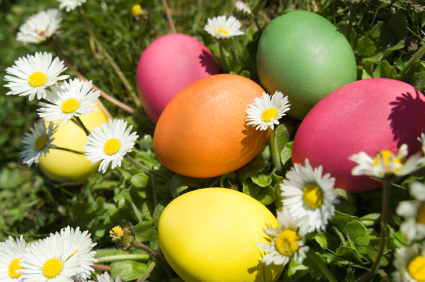 *Easter Symbols:
Easter Bells are rung in France and Italy throughout the year but they are not rung on the Thursday before good Friday. They are silent as way to remember the death of Jesus. They are then rung on Easter Sunday as way of telling people Jesus is alive again.
The Cross is the symbol for the Christian religion as Jesus was nailed to a cross but then came back to life.
The Easter Lily was a reminder to the Christians of how Jesus came back to life. The white Easter Lily is used in many Easter services. It is supposed to be a symbol of the purity of the Virgin Mary.
Easter Flowers such as daffodil, narcissus and the tulip are symbols spring and rebirth because they bloom in the spring.
Pussy Willows are picked at Easter in England and Russia. People tap each other on the shoulders with a branch of the pussy willow for good luck.
Lambs are a symbol because people thought of Jesus as the Good Shepherd who would watch over them as if they were His lambs. Lambs are born in spring. The Israelites also used lamb's blood to save their firstborn in ancient Egypt. Perhaps more significantly is that Christ is also referred to as the "Lamb of God" because He was perfect and pure and sacrificed Himself for us.
Rabbits are reminder of spring and new life and. They were reportedly the favorite animal of the spring goddess Eastre because they represented fertility.
Eggs are a symbol of spring as well as Easter. They are a sign of new life.
Chicks are born from eggs and are a reminder of spring and Easter.
Candles give light in darkness. Jesus is seen as "the eternal light" showing Christians the way from death to eternal life.
Palm Branches are used as a symbol of peace.
Bread or hot cross buns, or even unleavened flat bread is eaten to remember Jesus's sacrifice.
Wine is drunk to remember Jesus shedding His blood for all of us.
Fireworks are believed to frighten away evil spirits. They also show that out of darkness comes light.
What is your favorite Easter tradition?
To win a decadent chocolate treat from Godiva, leave a comment below. Since Godiva tends to run out so quickly of their fun holiday treats, all I can promise is that it will be wonderful!!! Once I pick your name as the winner, I will order the Godiva chocolate and have it sent directly to you.
To enter to win, leave a comment telling me your favorite Easter custom, your email address, and if you prefer dark, milk, or light chocolate, and I will do my best to get your favorite.
That's it. Good luck!
Legal stuff: Limited to US and Canada addresses only. Odds of winning depend on the number of entries received. Void where prohibited.
*symbols were taken from here


4 comments:
Hi Donna!
Thanks for the awesome blog! I had no idea that Easter started as something else! And harder still to think we celebrated in ANY day of the week? (Imagine hunting for Easter eggs before getting the kids out the door to school. LOL!)
Happy Easter!
Donna #2 =)
I agree, this is really an awesome blog. But if you want a more detailed explanation on the truth about Easter, I suggest that you check out this DVD: http://passionfortruth.com/TheTrueMeaningOfChristmasAndEaster.html
Happy Easter!
I have to agree that it would be a lot easier if we celebrated Easter on the 2nd Sunday. Although, I did enjoy being the only kid growing up who actually knew when Easter was (the first Sunday after the first full moon of the Spring Equinox).
I remember my older brother and I would practice finding Easter eggs about a week or so before the big day. My mom would get out the plastic eggs and we would take turns hiding them in the house. We had such a blast “fine toning” our egg detecting skills. We would hid them in the most difficult places trying desperately to out-do each other. I think we had more fun practicing than we ever did Easter morning.
Milk Chocolate
Kali_Edwards@hotmail.com
Congratulations, Kali. Your are my chocolate winner!
Post a Comment