Showing posts with label regency romance novels. Show all posts

Friday, July 7, 2023

Regency bathing suits


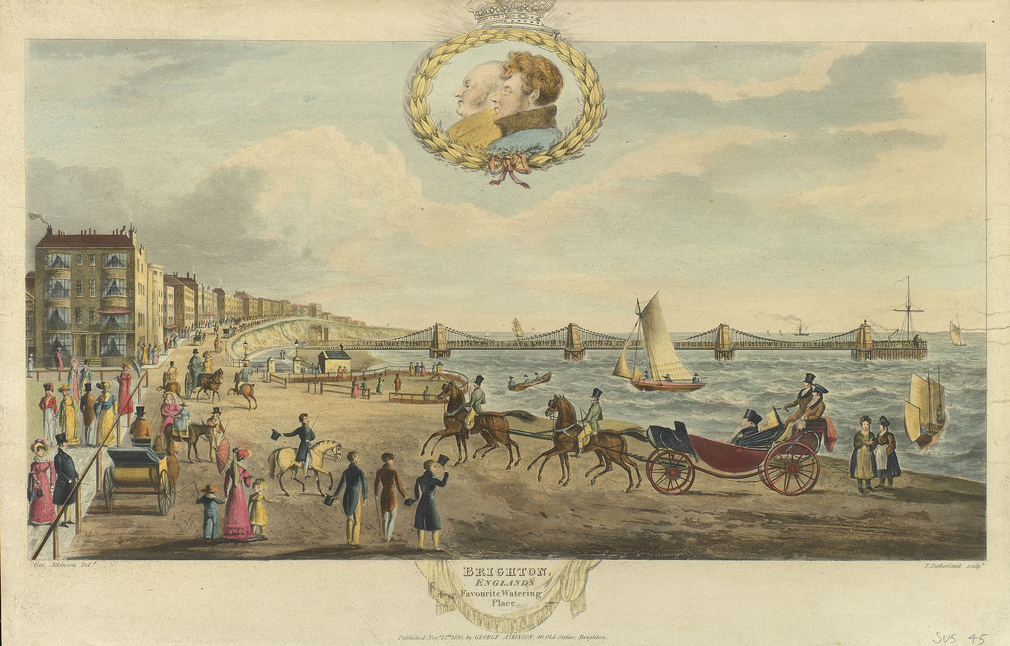
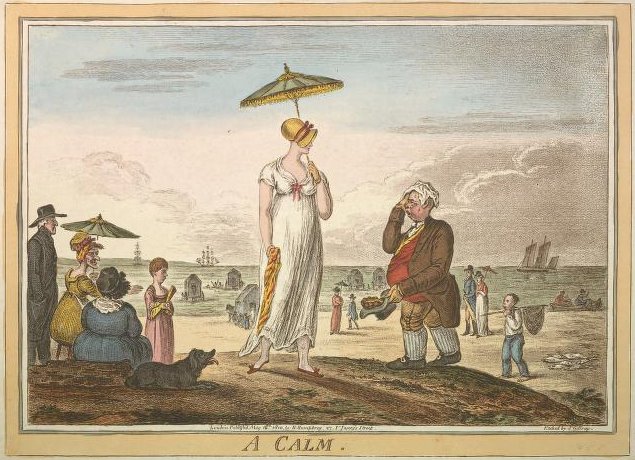
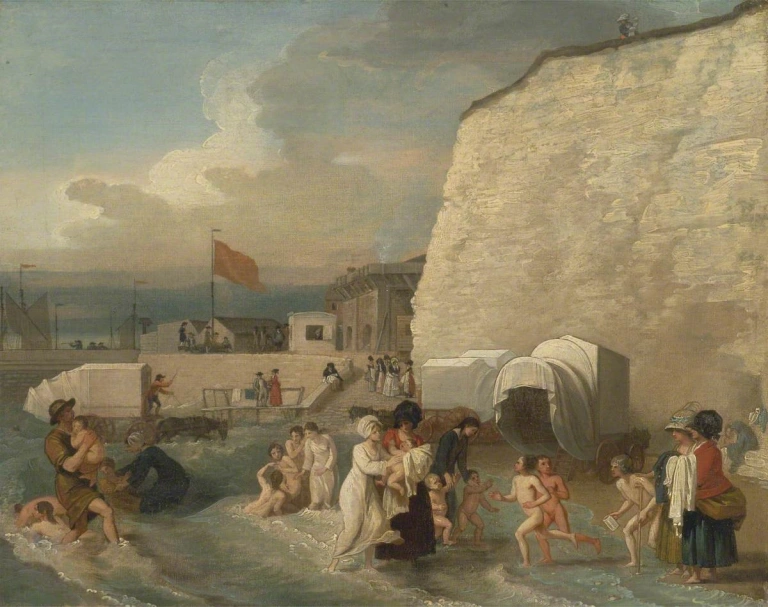
A Calm Day (at the beach in Brighton)

Ah, summer! The warm months invite a variety of activities best enjoyed outside such as hiking, fishing, water sports, and swimming to name a few. I love to swim, and so do some of the heroines in my Regency romance novels. Since many readers report that reading about the fun and beautiful clothing characters wear is one of the reasons they read historical novels, this begs the question: what did ladies in Regency England wear when they swam or visited the seashore?

Brighton

Historical Swimsuits

Swimsuits, also as bathing costumes, have evolved over the years. Even the concept of what to wear while swimming has changed. However, having special clothing for such a delightful activity is a relatively new concept.

So back to the question: what did Regency-era people wear while swimming?

The short answer is: anything they wanted. Even nothing, if they so desired. 

Are you scandalized?

Ladies would not swim--or would they?

Before I go into clothing, I should point out that some historians claim that until the last hundred years or so, women in general, and ladies in particular, didn't know how to swim; it was considered unladylike.
I agree it's unlikely the average well-bred lady in Regency England swam in lakes, rivers, or the ocean because the water was probably extremely cold. For much of that era, Europe experienced a mini Ice Age. Also, wet clothing is bulky and can get tangled in limbs, not to mention a lot of cloth becomes practically transparent, so swimming was probably frowned upon for safety and modesty reasons.

However, kids weren’t all that different then than now. Show me a kid who won't play in water even if the weather is chilly and I'll be shocked. Like most children, I have always loved to swim, cold water or modesty or not, so I assume plenty of girls in Regency England, even daughters of gentlemen, grew up swimming or at least playing in the water. Surely most of them had someone who could teach them to swim if they so desired because, really, nothing is as refreshing as cold water on a sunny day. And I have evidence to back up that theory; period drawings.
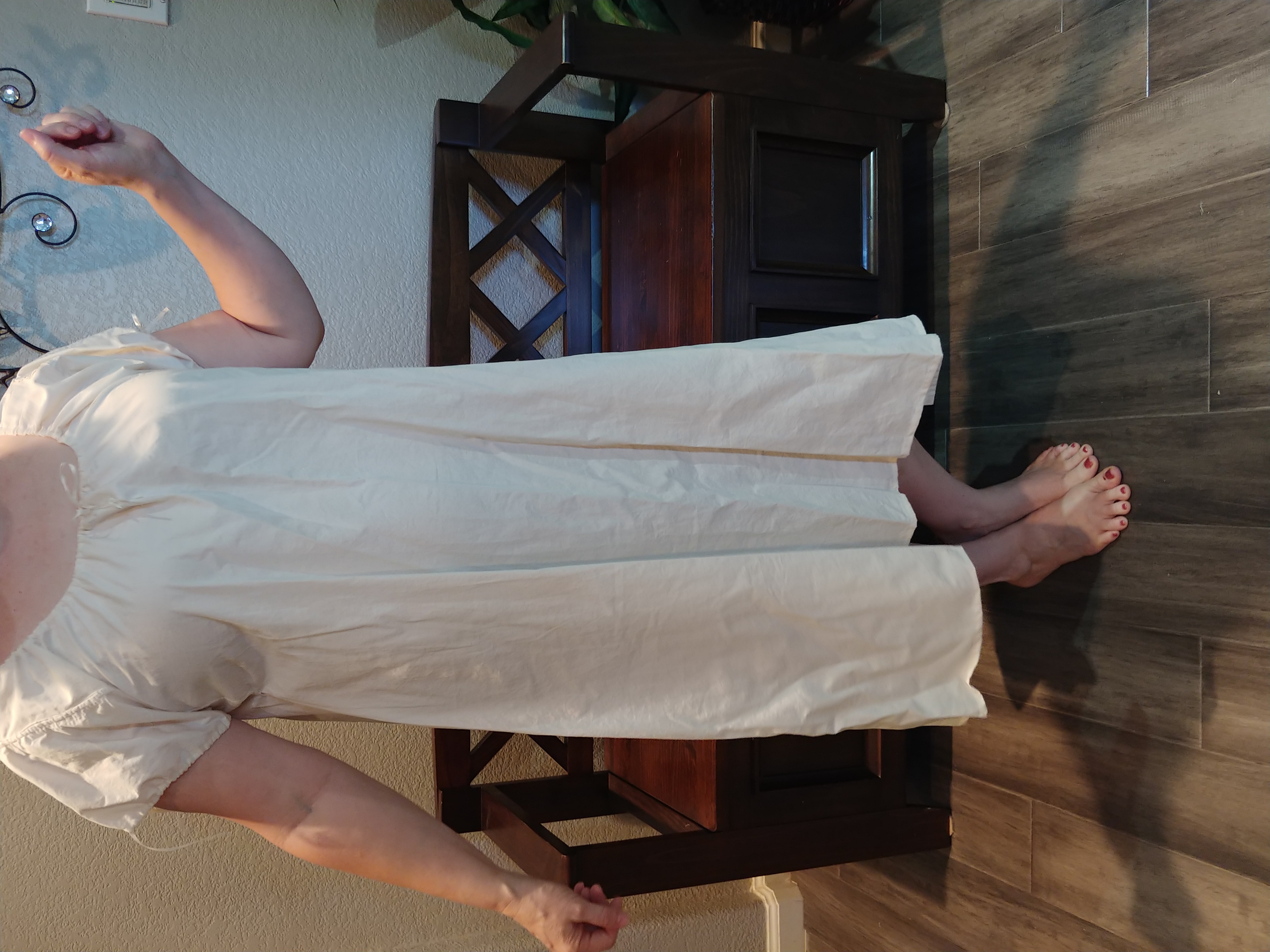
Regency shift
modeled by yours truly
copyright Donna Hatch

Bathing suits or the lack thereof

None of my historical fashion books mention clothing worn while bathing or swimming until the late Victorian Era, At that time, sea bathing attire became fashionable at seaside resorts. But during the Regency, nothing was quite so standardized.

Swimming in the nude, at least in non-public places, seems to have been the norm--especially for men and children. Ladies, however, seemed to wear whatever they wanted (or whatever their mothers dictated).

Women generally either swam naked or wore a shift, (pictured to the right) which is the undermost layer of clothing, made out of muslin. One source mentioned women wearing a long flannel shift while bathing, but I have never heard of a shift made of flannel--only petticoats, which are different. It's possible some wore a shift especially made of flannel for playing in the water.
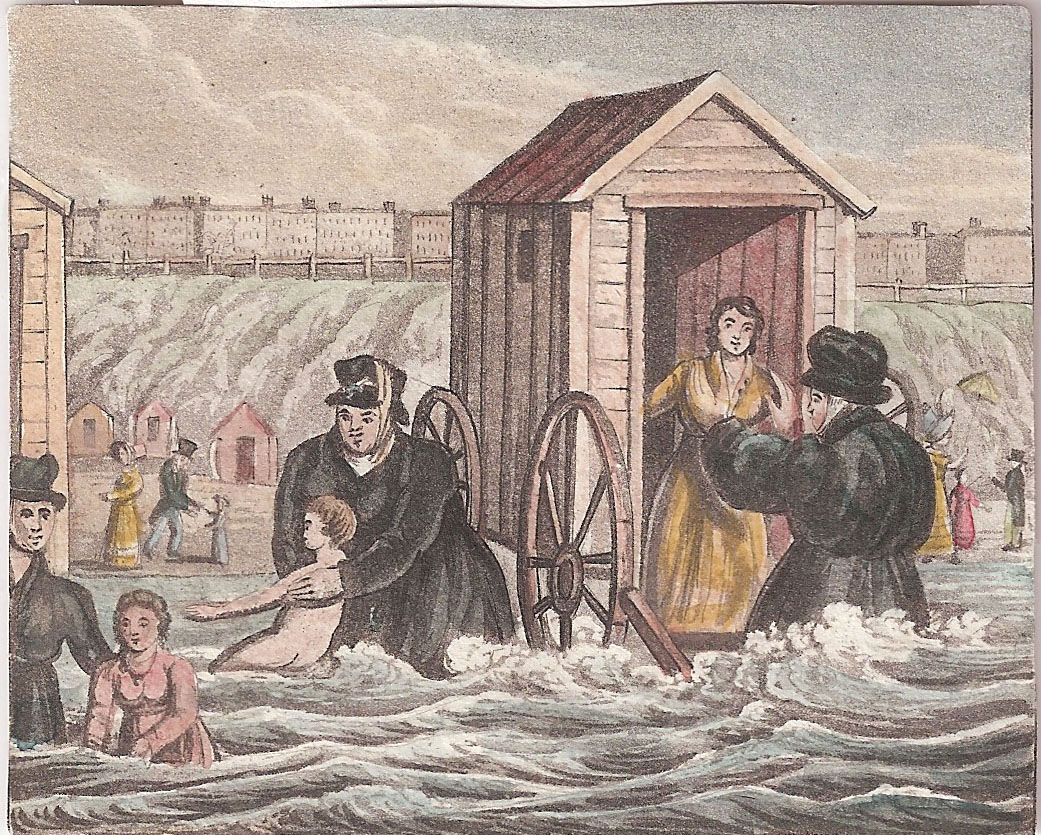
Bathing machine

If you're thinking, "dresses float up," you are right. To combat that, women sometimes wore shifts or gowns with lead weights sewn into the hem to keep them in place. This seems to be most common in Bath while bathing in the Roman baths for health reasons where men and women often all bathed together in the same pool. (more about Bath here.)

Resort Towns

In Brighton, a fashionable seaside resort, the genders often swam separately, most often at different beaches so modesty would have been less of a concern.

Often, men, women, and children all frolicked in the water together, as seen in the image above left labeled Seaside Resort.
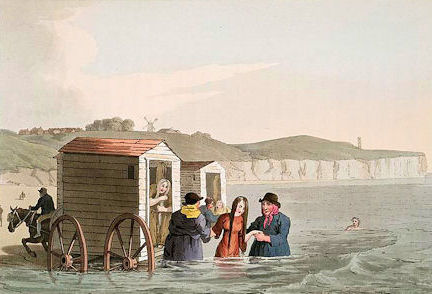
Bathing machine in Brighton

Bathing Machines

Ladies who could not swim or wished to do so with a measure of privacy used bathing machines -- small closed carts pulled by a horse into the ocean until the water level roughly matched the floor of the changing room. Inside, the bather undressed or changed, then stepped down the stairs into the water.

Although I expect it was less common, men used these bathing machines as well, also aided by a bathing attendant. Female attendants were called dippers and male attendants were dunkers. 

By the 1890s, bathing machines stopped being a means of getting into the water and instead became stationary changing rooms.
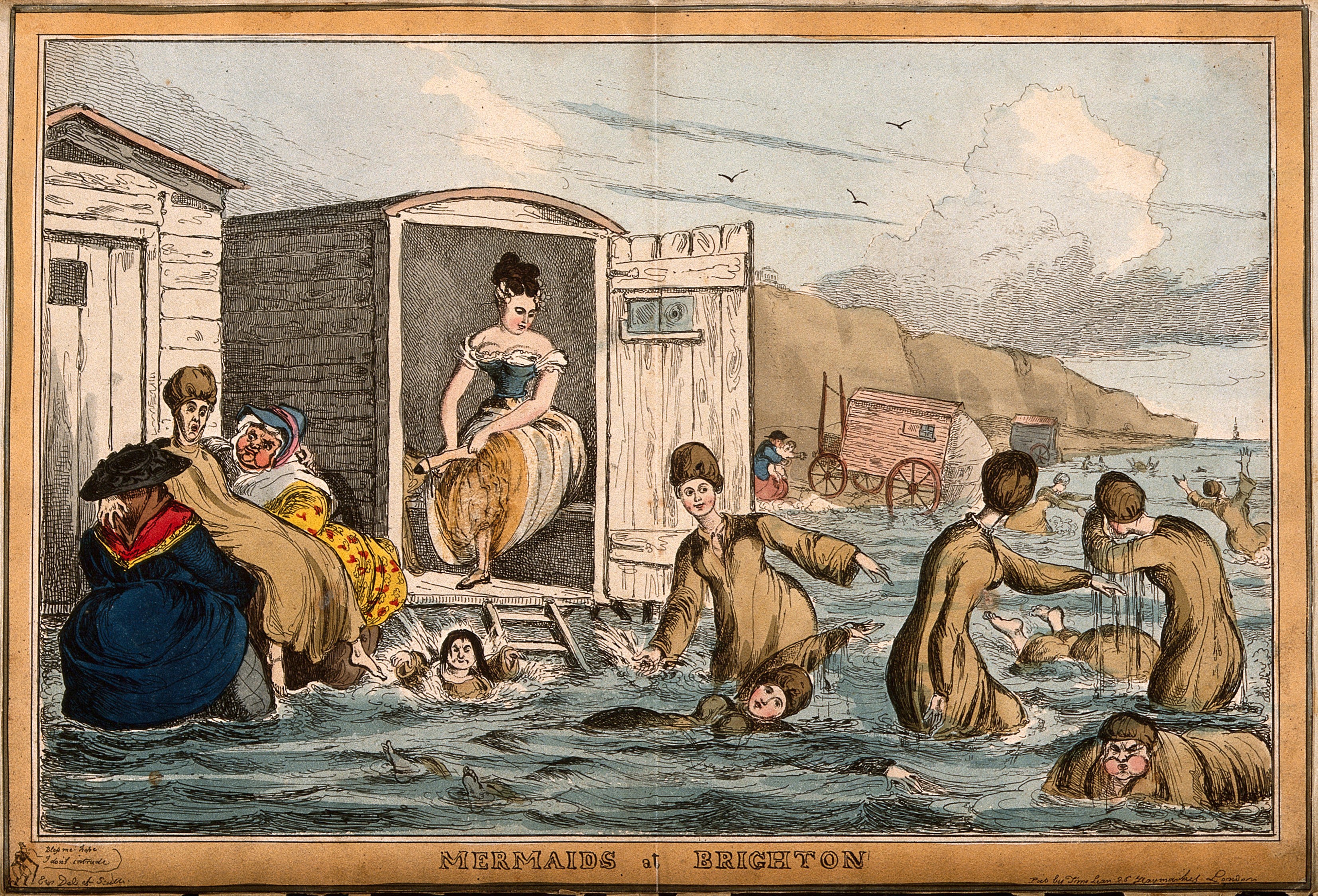
Bathing attendants

Pictured to the right above, bathing attendants wearing dark blue woolen gowns, probably weighted, help a fragile creature into the water. Attendants ensured the bather dunked herself or himself into the saltwater, believed to be healing, or ensured they didn't drown. Or both.

The image to the left show a variety of confidence in the bathers. They all appear to be wearing long-sleeved gowns which had the added benefit of protecting skin from sunburn as well as an increased measure of modesty. Whether the gowns in this image are all brown because that was fashionable or because the artist chose to make them all the same color, is open for discussion. 

I find it interesting that the dippers in both images are wearing dark blue but no one else is. Make of that what you will.
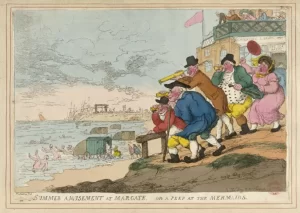
Mermaids

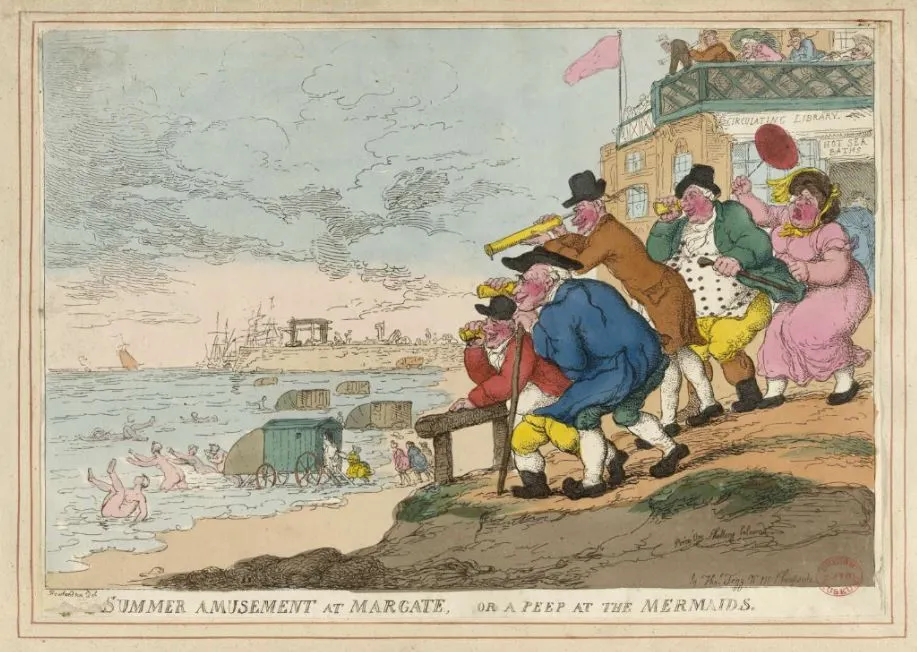
Plenty of drawings, such as the one to the right, show men peeping at bathers or "mermaids," some who are wearing nothing and others wearing their revealing wet shifts. 

I love the addition of the woman in pink about to bash her man over the head for peeking at other women. Serves him right!

Proper swimwear? 
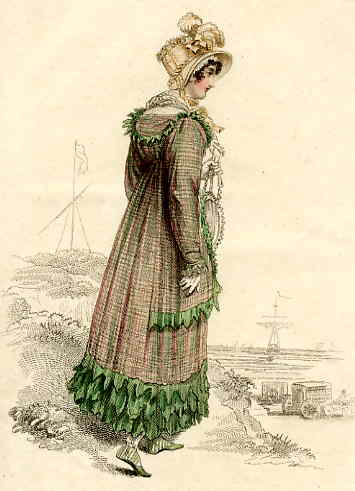
‘Sea Side Bathing Dress’
La Belle Assemblée
 August 1815
Several images in both La Belle Assemble and Acknerman's repository (famous fashion magazines of the time) feature ensembles labeled Seaside Dress or Bathing Dress. Make no mistake, they were not dresses meant to be worn while swimming in the water; they were walking gowns or morning gowns worn while walking to and from bathing machines or to promenade fashionably along the beach. 

The only mention of an ensemble made for swimming mentions a corset that is easy to into and out of without help. But that's nothing new. Short stays served that purpose, as well.

Real proper historical swimwear

No ensembles for swimming or sea bathing appear in fashion prints until the mid to late Victorian Era, probably due to the Victorian sensibility of modesty. 

At that point, many resorts banned naked swimming and enforced the wearing of proper swimwear.
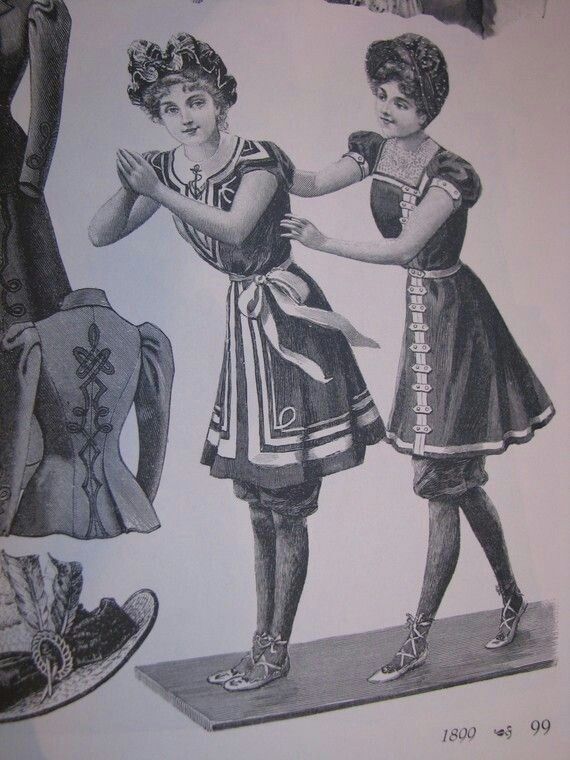
Bathing costumes, circa 1899
Historical Bathing Costumes

Though these designs date after the Regency Era, I thought they were fun and wanted to share them.

To the right is an image of early Victorian swimwear labeled bathing dresses and hats from 1870. I believe the nearly transparent women's faces are not meant to be ghostly but rather a bleed-through of illustrations on the other side of the page. Note the dark colors and clearly thick fabrics. Both have pantaloons and some kind of overskirt. One shows short sleeves and the other has long sleeves. Clearly, these are meant to be worn with a corset, although I cannot imagine trying to swim in a corset! I'd think the thick dresses would make swimming difficult enough. 

Bathing costumes
circa 1870
To the left is an advertisement of two Edwardian ladies modeling period bathing suits, dated 1899. Their sleeves are short and the fabrics appear to be lighter weight. They also seem to have corsetted waists, or maybe that's just the artist's rendering. I like the hats in both images and enjoy seeing their evolution.

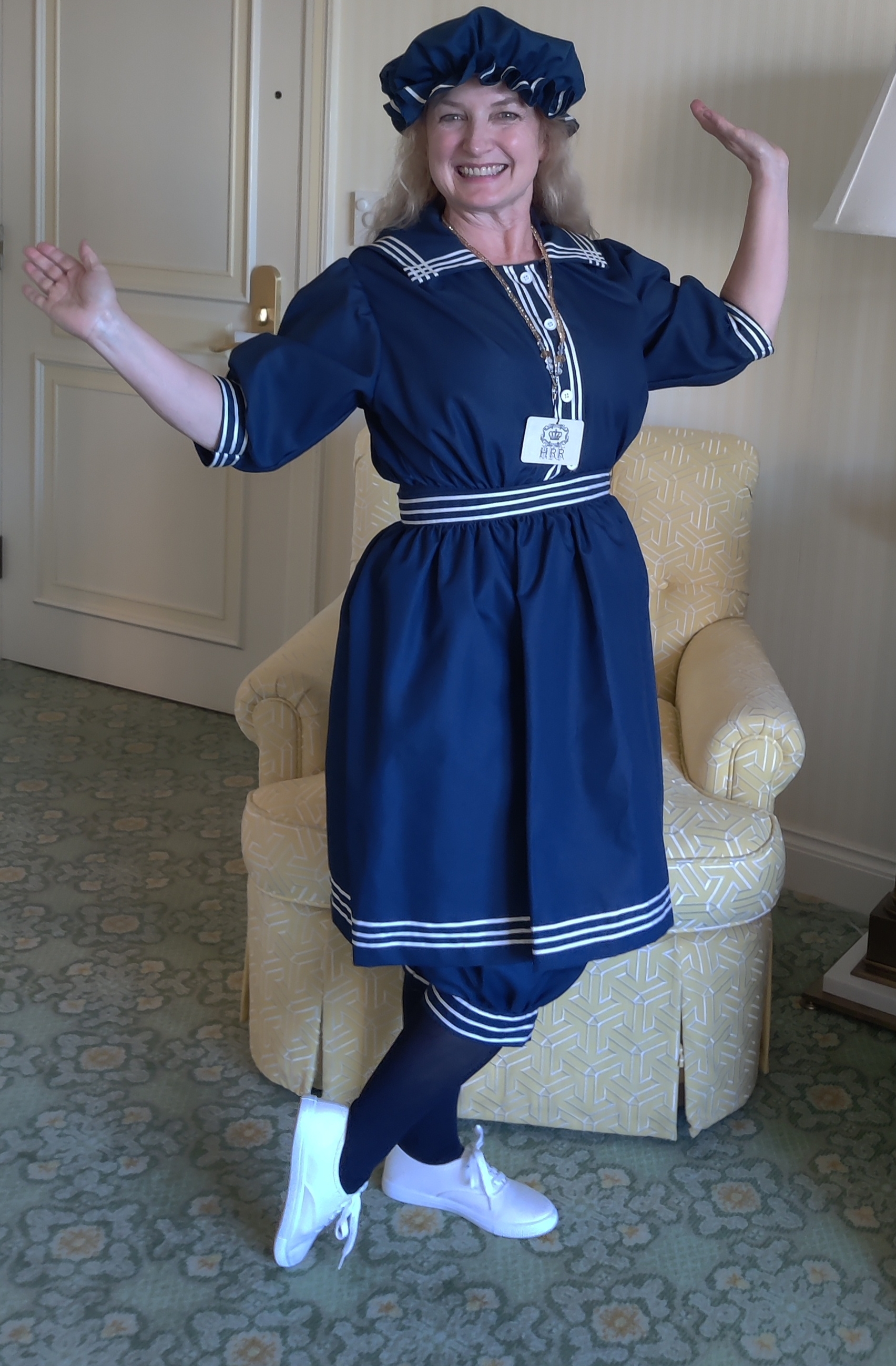
To the right is a photo of some weird chick (who, me?) wearing a proper bathing costume from approximately 1910. Note the dark blue thick fabric and modest design which includes, pantaloons, and skirt, similar to the 1899 image. I am not, however wearing a corset!

The hat, dark stockings, and white shoes are period appropriate for that era but I'm sure ladies removed them before going into the water. I wasn't brave enough to test out how well I could swim while wearing all of these layers--mostly because I borrowed the costume and didn't want to risk it fading in the chlorinated pool water of our hotel.

Which costume is your favorite?

Sources:

Sue Berry Historian, Sea Bathing in Brighton

the Jane Austen Centre, The Georgian Practice of Sea Bathing

Jane Austen's World, Regency Sea Bathing

Jane Austen's London; Mrs. Bell

All Things Georgian, Regency Swimwear

Fashion History Timeline, A History of Women's Swimwear

Word Wenches: Keeping It Clean


Wednesday, July 27, 2011

Historical Accuracy....Important or just too nerdy?

In my on-line writing group for Regency Writers, some of us were bemoaning the fact that so many novels labeled historicals are historically inaccurate. In the 80’s, historicals were pretty much anything goes. A few authors did a great job of blending a great story with historical accuracy, but many best-selling authors just wrote whatever they wanted and didn’t worry about too much about. Unfortunately, publishers let them get away with it and readers swallowed it. Now don't get me wrong, they crafted wonderful stories with wonderful characters, but they created their own rules which many readers accepted as fact but were, in fact, myth.

A prime example of this is the myth that marriage could be quietly annulled if it wasn’t consummated. I don’t know who started that, but it is unarguably false. There was an ancient Scottish tradition that allowed for annulment in certain circumstances if the marriage was not consummated, but for all intents and purposes, marriage was permanent especially in England. Furthermore, in England, annulment was messy and scandalous and never, ever happened quietly. It also socially ruined both the husband and the wife. Even divorce was difficult to obtain until King Henry VII legalized divorce in England, and even then, never became an easy thing to do until late in the 20th century.

Today, more and more publishers are looking for historical accuracy, but still not enough to satisfy many history geeks. The winner of a nationally recognized historical contest began her Regency novel with a grand wedding full of descriptions that are modern inventions which never happened in that era. Why did she win? Probably because it was a lovely fantasy that blended history with modern-day traditions, and she was a good writer. Too bad the judges overlooked the fact that it was historically inaccurate. A few hours spent in research would have won her not only the contest, but the respect of other Regency romance authors and the well-informed readers who know better. However, she probably understood that readers have a certain expectation and wanted to meet that instead of rely upon historical accuracy. Balancing reader expectation with historical accuracy can be like walking a tight rope.

Why do we care about historical accuracy? Several reasons.

First, it’s true. The fiction comes from the plot and the characters, not the setting.

Second, it helps preserve our heritage.

Third, we can learn from the past and see that maybe the good old days weren’t all that good, which helps us appreciate our day....or that the good old days really were wonderful and should be treasured--and remembered.

Fourth, many readers (and writers) are fascinated with that era and want sources to guide them through it.

Fifth, keeping an accurate backdrop helps shape the characters. Research is more than just learning about what the clothing looked like, or what kind of carriages they drove; it’s about society and people, how they behaved and what their expectations and frustrations were. It’s a realm long gone and our only doorway back is through painstaking research.

Some say, “Oh, well, it’s the story we want and the fantasy that entertains us.” To that I say, “Well, fine, then label it a fantasy, not a historical.” If you’re going to call a novel Historical, or Historical Fiction, do the research. I know it's a pain. A few years ago, I had characters nagging me to write their stories but I resisted because I didn't want to do the amount of research that would be required. Finally, when they wouldn't leave me alone, I broke down and began researching. It's hard, and frustrating, and very time consuming. But it was worth it. The fruits of my labor became the Rogue Hearts series, beginning with The Stranger She Married and The Guise of a Gentleman. Are they 100% accurate? Well, I thought so at the time, but since they were published, I have uncovered research which spells minor inaccuracies. The point is, I tried, and none of my errors are glaring. No, I'm not fessing up as to what was wrong. :-)

Because I get asked this a lot, here are some of my favorite Regency research sources:
Jane Austen is without a doubt the most reliable source since she wrote her books while living during that time.
Anything written by Dee Hendrickson is outstanding and carefully researched -- her Regency Reader is a resource I turn to over an over, and it's on CD so it's easily searchable.
Also Georgette Heyer was very careful, especially considering she didn't have the internet to aid her.
Here are some others:
Our Tempestuous Day by Carolly Erickson
The Half Mad Lord by Thomas Pitt
Georgette Heyer’s Regency World
Regency Etiquette: The Mirror of Graces, 1811, by a Lady of Distinction
The Regency Companion, Sharon Laudermilk and Teresa L Hamlin

In the midst of the on-line ranting, one of the published authors in my group shared with us her philosophy:

As a writer, my job is threefold:

1) do my homework well enough to please my fellow history geeks,

2) make the story compelling enough to hook readers who don't care whether or not it's accurate, and

3) don’t stress over writers/readers who prefer the fairytale.

It resonated within me. I hope it helps you, too.

Saturday, May 21, 2011

Drawing for Constant Hearts

To celebrate the release of my new Regency Romance novella, Constant Hearts, on Smashwords, I'm giving away a free copy to one lucky commenter. I may pick two if I'm in a good mood ;-)

So, tell me either why you like romance, or why you like Regency, and you're in the drawing. It's that simple.

Want more chance to win?

Follow my blog, or tell me you already are, and tell me you have here in a comment, and you get in the drawing twice.

"Friend" me on Facebook, or "ike" my Author page on Facebook, and tell me you have here in a comment, and you get entered another time. That's it. A simple way to win a free Regency Novella e-book.

Good luck!

Wednesday, May 18, 2011

Regency Ladies and Double-Barrel Flintlocks


In my Regency Romance, The Guise of a Gentleman, my Regency lady was faced with a group of bad guys. Since I'd done my research, I knew if she were to defend the man and boy they were trying to kill, she'd only be able to get off one shot because of the time and difficulty loading guns. So, I'd decided to either have her ride with two loaded guns or have a groom riding with her. Then I found just what I needed: a double-barrel flintlock which could fire two shots, without having to reload. Huzzah!!!
Most Flintlock pistols were from 10 to 16 inches long, from butt to barrel muzzle. They would weigh from one to four pounds, depending on the caliber and the number of barrels. There were a number of double-barreled pistols during the Regency, but they were generally big and heavy. There were two types, the over and under, with a revolving lower barrel, but only one hammer, so that the pan had to be primed before firing again. Ladies’ pistols were generally six to eight inches long.  A bullet for such a small gun would be no wider than this: / /.
The real problem was that the flint, amount of powder, and mechanisms has to be smaller, which made them firing them successfully more difficult.
Here's a picture of small woman’s pistol. It's is six inches long. You can see that too small to hold a ramrod. The ladies’ pistols weighed between 12 oz to one and a half pounds.


Here's a shotgun, circa 1798 to 1804. Overall length is 44 1/2", barrel length is 29", and the gun weighs 7.3 pounds.
It has a side-by-side barrel, like a double-barreled shotgun . And like the shotgun, it has two hammers, though you can't see the second one behind the first. It also has two triggers, one for each barrel. It's a .54 cal. and the damascus barrel is nine inches long and weights close to three pounds.

This Double-Barrel Flintlock Pistol of Napoleon is a replica of the original of this side-by-side double-barreled flintlock pistol from Napoleon's private armory and bears his insignia on both sides of the grip. Made by Gribeauval, Napoleon's personal gun maker, the pistol originated in the French unmaking center of St. Etienne in 1806. Unusual for its day, the double-barrel configuration provided a decided advantage over its single-barreled counterpart, given the notoriously slow reloading procedure for flintlocks. The barrel is just under eight inches long and it weighs about 2 pounds.
Even though ladies’ pistols and double-barreled pistols look different, they were loaded the same way as all flintlocks. Most all flintlocks were smoothbores. Some were rifles, with spiral rifling in the barrels. They were difficult to load because the bullet had to be seated against the rifling groves to actually spin the ball, so it was hard to ram home. Cloth or leather was wrapped around the ball, and the cloth against the rifling was easier to get down the barrel.

So, if you wondered what Elise used to save the hero and the boy from the cutthroats about to kill them, here you are, proof and everything.
The Guise of a Gentleman, winner of the Golden Quill Award
"Combining Jane Austen with swashbuckling adventure, The Guise of a Gentleman is a fine specimen of pirate romance!" NY Times bestselling author Jennifer Ashley

The widowed Elise is a perfect English lady living within the confines of society for the sake of her impressionable young son. Her quiet world is shattered when she meets the impulsive and scandalous Jared Amesbury. His roguish charm awakens her yearning for freedom and adventure. But his irrepressible grin and sea-green eyes hide a secret.
But his irrepressible grin and sea-green eyes hide a secret. A gentleman by day, a pirate by night, Jared accepts one last assignment before he can be truly free. Elise gives him hope that he, too, can find love and belonging. His hopes are crushed when his best laid plans go awry and Elise is dragged into his world of violence and deceit. She may not survive the revelation of Jared’s past…or still love him when the truth is revealed.

Tuesday, May 17, 2011

Constant Hearts

My new Regency novella, Constant Hearts, inspired by Jane Austen's Persuasion, is available now for only $1.99 at Smashwords. If you like it, please leave a rating and a review and help spread the word.

The scandalous Lady Amelia Dasherwood would rather thumb her nose at the society who shunned her for getting a divorce, but must now face those who rejected her in order to solicit aid for a forgotten orphanage dear to her.

Newly returned from the horrors of war, Dr. Reed St. Ives plans to make a new life as a country doctor and forget Amelia ever existed--after all, she broke his heart when she married another man. Yet she keeps invading his thoughts and showing up when he least expects her. If only he could find a cure for his own heart.

When fate reunites them, the last thing they want is to face the heartbreak that tore them apart years ago. Amelia must choose between honoring her family’s wishes to deny her heart again, or declaring herself and risking Reed’s rejection. Placing her heart at his feet would take the most courage of all.

Friday, February 4, 2011

Blogging in paradise

Today my very special guest is Kim Adams, creator of the very popular SOS Aloha Blog.

Q: What is your typical day like?

I am a romance blogger living in Paradise! I wake up to sunshine, check the romance blogs (since we are five hours behind the East Coast), and take a walk along Pearl Harbor – it reminds me how thankful I am to live in freedom. I blog at night after the children have gone to bed. But I frequently have to double check it in the morning for midnight errors!

Q: Tell me about your blog.
I write a blog, www.sosaloha.blogspot.com, to promote romance reading, military families and Hawaiian culture. It is an outreach of Kathryn Falk’s military charity, SOS America (Kathryn Falk is the founder and CEO of RT Book Reviews.)

Q: What influenced you to write this blog?
Each year, RT hosts a Booklovers Convention. It includes the SOS Military Tribute. After the SOS Military Mixer in Orlando/2009, readers asked how they could support military families. So I created a monthly newsletter to spotlight organizations that support military families, authors with military connections, and international holidays (to honor the different cultures where military families live). Several readers encouraged me to transform the newsletter into a blog, so I posted my first blog on March 3, 2010. Over the past year, it has morphed from a monthly newsletter to a daily blog. I giveaway romance books donated by publishers, authors, and reviewers. I also giveaway Hawaiian trinkets in the spirit of Aloha. My blog is open to all readers – not just those connected to the military.

Q: Are you a fan of romance?
Oh, yes and I'll tell you how I fell in love with romance as it's a fun story! I worked as a contracts officer in the Air Force. I did not read any books off duty. After getting married and leaving the Air Force, my husband was reassigned to a NATO assignment in the Netherlands. At that time, NATO deployed peacekeeping troops to Afghanistan. The deployed personnel called back to the headquarters unit to request donations for local orphanages. Since I was a volunteer in the American Spouses’ Thrift Shop, we literally emptied our shelves with clothes, shoes, and toys. Left behind were romance books. A blue book with a red tartan called to me – Cathy Maxwell’s A MARRIAGE CONTRACT. Considering I was living across from a castle and taking tea with the British ladies, it was a perfect storm to become hooked on romance books and the Happily Ever After. It is pure escapism from the war business. After we moved to Baltimore, I attended my first RT Booklovers Convention and discovered SOS America. And the rest is history!

Q: What’s the craziest, bravest, or stupidest thing you’ve ever done?
I frequently blog about my travels through Europe as a new Lieutenant with my friends (before I met my husband). I have promised to share the story about meeting East German students in a Prague beer hall at RT in the bar.

Q: That sounds like a great story! Kim, I applaud you for your efforts and wish you much success.

Mahalo, Donna, for giving me the opportunity to promote SOS Aloha! I invite you to join me in virtual Hawaii for a bit of sun, romance, and history!

And one lucky blogger will win this Hawaiian trivet as a "door prize" so leave a comment!

Kim in Hawaii
www.sosaloha.blogspot.com

Wednesday, November 17, 2010

English Autumn and Winter Holiday Traditions


English Holidays and Winter Fare
by Shannon Donnelly

In the still largely agrarian world of the early 1800's, autumn and winter became a time to relax after harvest. Gentry and yeoman alike could take advantage of old feasting customs that had long ago mingled with the Christian holidays.

In autumn, Parliam ent opened again and some of society returned to London. St. Michael's and All Angel Day, or Michaelmas, at the end of September, marked the end of a quarter year. The Celtic calendar also wove itself into English holidays, with one of the main events on November 1 becoming All Saints Day or All Hallows and October 31 therefore set as All Hallows Eve. It should be noted that Saman (also Samana, Shamhain, and Samhain) a minor Celtic guardian of herds, and so important to a herding society, played a part in the celebrations, but modern lore has turned him into an ancient god of death and mixed up several Celtic customs along with imported Christian beliefs to give us Halloween.

October was a month when land owners ate pheasant, partridge, duck and grouse. Fish for meals included perch, halibut, carp, gudgeons, and shell fish. Poachers also looked to snared hares for their pot. Beans were still fresh, and the fruits of summer gave way to pears, apples, nuts and the last harvest of grapes.

On November 5 bonfires burned in mockery of Guy Fawkes and memory of the Gunpowder Plot to blow up Parliament. The Feast of St. Martin, or Martinmas, fell on November 11, and St. Andrew, the patron saint of Scotland, had his day on November 30. St. Andrew's day also marked the beginning of Advent to celebrate the four weeks before Christmas. In November, the landed gentry still dined on wild foul as well as domestic poultry—which was now getting a bit old and aged (meaning tough and needing sauces to make the meat palatable). They also had beef, venison and pork with their meals. Fish could still be caught and served, and winter vegetables graced the dining room, including: carrots, turnips, parsnips, potatoes, leeks, cabbage, celery and lettuces. With November, walnuts and chestnuts came into season.
More celebrations lead to Christmas Eve when the Lord of Misrule danced and the Mummers traveled to perform their pantomimes. Then came Christmas Day, and Boxing Day on December 26, which was St. Stephen's Day. Boxing Day did not get its name from gift boxes, for the exchange of gifts was a German custom still new to Regency England. Instead, Boxing Day got its name from the older tradition of it being a day in which pleadings could be placed in a box for a judge to privately review. In December, besides beef and mutton to eat, pork and venison were served. Goose was cooked for more than just the Christmas meal, and there would be turkey, pigeons, chicken, snipes, woodcock, larks, guinea-foul, widgeons and grouse to eat. Cod, turbot, soul, sturgeon and eels joined the list of fish in season. Forced asparagus added a delicacy to the usual winter vegetables. Stored apples, pears and preserved summer fruit appeared on the better, richer tables. Mince pies made from mincemeat, which has no meat in it, were another traditional fare, with the tradition being that everyone in the household should stir, for luck, the mix of dried fruit and spices before it was baked.

Households also celebrated not just according to the season, but also to the customs of the area. In the Regency, local customs in the countryside might well hold to the old ways.
For one of my books, Under the Kissing Bough, I needed a Christmas wedding and customs that suited the countryside around London. In ancient days, a Christmas wedding would have been impossible for the English Church held a "closed season" on marriages from Advent in late November until St. Hilary's Day in January. The Church of England gave up such a ban during Cromwell's era, even though the Roman Catholic Church continued its enforcement. Oddly enough a custom I expected to be ancient—that of the bride having "something borrowed, something blue, and a sixpence in her shoe"—turned out to be a Victorian invention.
For Christmas customs, I relied on those that have carried down through the ages: the Yule log from Viking winter solstice celebrations (which gives us Yule Tide celebrations), the ancient Saxon decorations of holy and ivy, and the Celtic use of mistletoe on holy days, which transformed itself into a kissing bough. Carolers might well travel from house to house, offering song in exchange for a wassail bowl—a hot, spiced or mulled drink, another tradition left over from the Norse Vikings.

The holidays were a time of games as well, and the game of Snapdragon is a very old one. It's played by placing raisins in a broad, shallow bowl, pouring brandy over them and setting the brandy on fire. Players then must show their courage by reaching through the spirit-flames to snatch up raisins. And the game even comes with its own song:

Here comes the flaming bowl,
Don't he mean to take his toll,
Snip! Snap! Dragon!
Take care you don't take too much,
Be not greedy in your clutch,
Snip! Snap! Dragon!

Celebrations continued to mix tradition and religion when the Twelfth Night feast arrived on January 5, which combine the Roman Saturnalia with the Feast of the Epiphany, when the three wise men were said to have paid tribute to the Baby Jesus. Deep in winter, there was still plenty of game to eat. Beside those wild and tame birds available in December, lobster came into season in January, as did crayfish, flounder, plaice, smelts, whiting, prawns, oysters and crab. Broccoli made a welcome change from the other winter vegetables, as did cress, herbs, cucumbers, beets and spinach. Preserved fruits would be running low in all but houses with large orchards, and stored apples and pears would have to serve guests until the expensive force strawberries of February appeared.

For the Celtic year, winter ended February 1 with the celebration of Imbolc or Oimelc. This is the time when ewes begin to lamb and lactate for their offspring, and life begins to return. For the ancient Celts, this was the celebration for Brigid (also Brigit, Brighid or Bride), the Light-Bringer, one of the main Celtic goddesses. She was strong enough to survive and be transformed by early Catholics into Saint Bridget, who was celebrated, along with the Virgin Mary, on February 2, Candlemas Day.

Another ancient tradition, this one of law, was to ignore leap year days—February 29 did not exist. This became the day when the world could be out-of-order. Tradition held that St. Bridget complained to St. Patrick about women having to wait so long for proposals, and Patrick answered that women could propose on Leap Day. In Scotland, their tradition added on that any man who declined a proposal in a leap year must pay a fine, which could be anything from a fine silk dress to a kiss given to the disappointed female.
St. David's Day the Welsh patron saint came on March 1, and tradition held that all good Welshmen should wear a leak—a vegetable readily available from winter fare. March also brought Lent, and in Shropshire and Herefordshire, Simnel Cakes made with saffron were made for the season.

With March 21, the spring officially arrived, but for most of England, it would still be some time before warm weather and spring flowers arrived, and even longer until the return of the lush abundance of summer fruit and foods.

Shannon Donnelly bio:
In a previous life, Shannon wrote romance novels set in the English Regency. Now she’s writing paranormal (as in next to, but not quite the usual) romances, and other things. Meantime, the dogs keep her busy, the garden always needs work, and she can be found on twitter@randomfreshink.

Monday, October 25, 2010

banks and checks


Paying for purchases in Regency England was very different than today. In those days, people did not carry around paper money or check books or credit cards. They paid for purchases with coins. A few places would accept bank cheques but that seemed fairly rare--mostly if the establishment already had an understanding with either the bank or the customer.

It was most common for a person to set up a credit account with establishment, which would then send a bill to the customer, or their man of business who would arrange for payment.

Paper money did not become common until long after Regency England. Cheque--or checks--became commonly accepted form of payment much later as well.

So if your Regency hero and heroine want to do some shopping, they'd either be carrying around a heavy money bag that jingles, or stick with favored shops with whom they had an account.

Sorta makes you think, doesn't it?

Wednesday, August 25, 2010

How to address a knight, and other mysteries solved


As a fiction author of historical novels, I must balance the fine line between realism and making the story easy for the modern reader. While it may be more accurate for a young couple falling in love to call each other Miss and Mister their entire courtship, that practice seems just too formal to our modern selves.
And what’s with all the etiquette? How does one know how to address anyone? So here you are, the in’s and outs of addressing a person. (I’ll deal with titled peers and their families at a later posting.)

First Names
First names were almost never used in speech, except in rare circumstances, before this century. Most sources suggest that only children who grew up together or very intimate friends ever called each other by given names.
If a child was born into a title, either courtesy or apparent, that child was often called by his title. For example, if the son was John Smith, the Earl of Wentfordshire, he was often simply called Wentfordshire, or some nickname like Went that went with the title.

According to letters and novels written at the time, married couples often used more formal terms, even in private, rather than calling each other by first names. Therefore, they were much more formal than what is commonly portrayed in historical novels. However, because of the modern reader’s expectations, I use first names (or Christian names) in my romance novel to subtly reveal a level of established intimacy to suggest growing feelings. In The Guise of a Gentleman, the heroine is appalled to find herself calling Mr. Amesbury by his given name, Jared, in her thoughts and frequently corrects herself until finally succumbing to calling him Jared.

The Honourable
"The Honourable" is a formal title which applies to younger sons of earls and all children of viscounts and barons (and the wives of those sons). However, this term is not ever used in speech…ONLY on envelopes. It is not included in the salutation of a letter. Therefore, it would be quite impossible to know, based upon and introduction, that a person holds the title of Honourable. I used the term “honorable” in The Guise of a Gentleman in an introduction as a way of a secondary character taking a jab at the hero when he introduces him to the heroine, but it would not normally be used in speech at all.
“Mr." and "Miss" weren’t used in with "The Honourable" in speech or in writing, only on the address of an envelope. The eldest Mr. Smith would be addressed thusly: "To The Honble. Mr. Smith." A letter to his wife would be "To The Honble. Mrs. Smith." If he is a younger son, he would be addressed as the Honble. Mr. John Smith and his wife, the Honble. Mrs. John Smith.

It is interesting to note that in Persuasion, Austen states:
"they had the cards of Dowager Viscountess Dalrymple, and the Hon. Miss Carteret, to be arranged wherever they might be most visible; and 'Our cousins in Laura-place,' -- 'Our cousins, Lady Dalrymple and Miss Carteret,' were talked of to everybody." (Vol. II, Chapter iv)

Apparently, using Honorable and Miss together was used on a calling card as well on an envelope.

The
"The" is a distinction only used for peers and families of peers, so baronets and knights would never use it. An Earl’s wife, for example would be the Lady Tarrington. A woman who has a title in her own right, meaning the daughter of a duke, for example, would be the Lady Eleanor Averston. The wife of a baronet or knight would be Lady Stover, but never The Lady Stover. However, if the usage is not a formal occasion, such as being presented to the queen, "The" may be dropped.

"Miss," "Mr." and "Mrs." With and Without Given Names
"Miss" used alone with a surname, refers to the eldest unmarried daughter. Other daughters would be distinguished by using their given names. For example, Miss Smythe would be the eldest daughter while Miss Mary Smythe and Miss Jane Smythe would obviously be younger daughters. Or, you could call them all the Misses Smythe. If none of her sisters are present, a younger sister would simply be called Miss Smythe.

"Mr." is used alone with a surname refers to the eldest son (of a viscount, baron, knight, or commoner). The younger brothers are called by their Christian names, like that of "Miss" in the previous example, and their wives have the same usage. , Mr. Worthington is the eldest son, and Mrs. Worthington is his wife; Mr. Thomas Worthington is a younger son, and Mrs. Thomas Worthington is his wife.

So there you have it. Next time, titles (and you probably thought this was complicated!)

Monday, July 26, 2010

Why romance?

People often ask me what's my obsession with romance novels and movies. It's pretty simple. I love the happily ever after. If a book doesn’t have a good ending, I feel like I’ve wasted my time because I read to escape my problems. I want to know good always triumphs over evil, and love conquers all--not be bummed because all was lost. Another huge reason I like romances is because I love watching the romance unfold and, of course, the euphoria of falling in love. Besides, it puts me in the mood. And my hubby likes that ;-)

Some of my favorite romance movies are:
Ever After
Enchanted
While You Were Sleeping
Somewhere in Time
Jane Eyre
And of course, all the Jane Austen movies; Emma, Pride & Prejudice, Sense and Sensibility, Northanger Abbey, Mansfield Park

I'd list my favorite romance novels but that would take a week.

What are your favorite romance movies?

Monday, July 5, 2010

Regency Balls, a vital part of courtship

Anyone who’s read Regency-set novels may have at one point asked the question: “Why does practically every Regency novel contain a ball?”

There’s a very good answer to that question and it isn’t because authors have no imagination. It’s because balls and dancing were a vital part of social life and courtship. Children at a very young age were taught to dance, even young boys who joined the army or navy.

Where were these balls held?

A public ’subscription’ ball, was held anyplace with an assembly room. Guests were admitted only if they possessed a purchased ticket. High ticket prices might keep out the lowest class, but didn’t stop the rich in trade from attending. (Horrors!) Subscription balls were held just about anywhere–the main room of an inn, a large clearing outside, or a rented public house.

Almack’s is an example of a public assembly but the matrons were very particular about who received a voucher to attend. No one was admitted into Almack’s without a voucher.

Gentlemen had to be considered eligible, but the “weeding out” process wasn’t so strict for the gentlemen as it was for the ladies. For a young lady to receive a voucher, one of the patronesses of Almack’s had to approve of her background and character before she was given a coveted voucher.

This picture is of a ballroom in Bath, where Catherine in Northanger Abby meets a dashing stranger who cleverly arranges an introduction.

A private ball was another matter. Most of the great houses had either a ballroom or a large drawing room. People were allowed to attend by invitation only. In Pride and Prejudice, the local matrons convinced Mr. Bingley to host the event and invite all the ‘good’ families because Netherfield house had a ballroom. Throwing a ball took a great deal of money; servants, candles, food and drink all cost a goodly amount, so only someone well off could afford it. Of course, since most Regency romance novels are about the beau monde, a ball is treated as common-place.

In my newest Regency, The Guise of a Gentleman, Elise is shocked to find that the seemingly common man who accosted her only days ago, is now present at a ball hosted by her good friend. Normally, only the very best ton would be present. What was he doing in such an elite gathering?

And most pressing of all, would he ruin her reputation and tell everyone he’d kissed her at their previous encounter?

The Guise of a Gentleman, available at Amazon, and The Wild Rose Press in both paperback and e-book.

Or, you can win a free copy (and you have four chances if you do all four):

1. Leave a comment in this blog, then send me an email at donnahatch29@gmail.com and put “free book” in the subject line

2. Follow my blog, then send me an email at donnahatch29@gmail.com, telling me you’re now following me and put “free book” in the subject line

3. Friend me on Facebook, then send me an email at donnahatch29@gmail.com, telling me you’re now my friend on Face book and put “free book” in the subject line

4. go to my website and then find out what is the name of the hero, then send me an email atdonnahatch29@gmail.com, telling me the answer to the question and put “free book” in the subject line

Remember, for each thing you do, you have another chance to win. Good Luck!!!

Friday, June 18, 2010

Why Do Women Read Romance Novels

Every once in a while, people ask me why I read romance novels. It usually surprises me because I think it's obvious. But maybe not. I read romance for several reasons:

*I am guaranteed a good ending
*I love the relationship and personal growth of the characters
*I love reliving the euphoria of falling in love which I feel that every time I read a romance novel
*It puts me in a good mood and I feel energized as if I can face the world again
*My husband likes the 'effect' it has on me ;-)

Why do you read romance novels? Let a comment and I'll enter you in a drawing for an e-book copy of my newest Regency Romance, The Guise of a Gentleman.

Monday, June 14, 2010

Regency Travel by Coach

Most Regency Romance novels are about the very wealthy, because, let's face it, most of us read as a form of escape. And what could be a better escape than vicariously living the lifestyles of the rich?

The very wealthy traveled by private coach, which came in all different shapes and sizes. The carriage pictured here is called a Scotland State Coach, circa 1830. Lovely, isn't it? Sigh. However, everyone else had to hire a coach.

In London, one hired a hackney which was like a cab with a driver, horse and some kind of used carriage. To travel a long distance, other arrangements had to be made.

The cheapest way to travel was on mail coach, pictured here. Travel was fast but very uncomfortable.

The next best way to go was by stage coach but it was crowded, and some passengers ended up riding on top in all kinds of weather. Unpleasant, to say the least.


A nice way to travel was to hire a carriage called a Post Chaise pictured here circa 1795. A post chaise could pick up passengers and drop them off anywhere specified, so a passenger could go from door to door, but usually passengers traveled from one posting inn to the next where the carriage and the horses were changed. The teams of horses always came with a postillion, a rider who rode on the back of one of the lead horses and controlled their travel. Generally it only had room for one seat, which seated two, but it also had an outside, rear facing seat for servants and a platform in front for luggage. Two teams could travel faster than a single team. The postillions changed every time horses were changed.

To figure how long it took to travel, here’s a good rule of thumb for figuring travel by horse: walking = 5 mph, trotting = 8-10 mph, cantering = 15 mph. All depends on the terrain. Naturally, horses would have to be changed on a regular basis and the faster one goes, the more frequently horses had to be changed.

Stage coach and mail coach horses were changed about every fifteen to twenty miles. They had a fast and efficient routine to get the teams exchanged in less than 5 minutes. It would take longer for a private individual who had to wait for available horses, unless they were ridiculously wealthy and boarded horses at various posting inns along their most frequently traveled routes.

One thing that slowed travel was the existence of toll roads. Though the mail coach traveled free, other commercial vehicles made arrangements with the toll authorities. Private carriages had to stop and pay the toll which included the number of horses and the distance to be traveled.


Monday, May 10, 2010

Why all the balls?

Anyone who's read Regency-set novels may have at one point asked the question: "Why does practically every Regency novel contain a ball?"

There's a very good answer to that question and it isn't because authors have no imagination. It's because balls and dancing were a vital part of social life and courtship. Children at a very young age were taught to dance, even young boys who joined the army or navy.

Where were these balls held?

A public 'subscription' ball, was held anyplace with an assembly room. Guests were admitted only if they possessed a purchased ticket. High ticket prices might keep out the lowest class, but didn't stop the rich in trade from attending. (Horrors!) Subscription balls were held just about anywhere--the main room of an inn, a large clearing outside, or a rented public house.

Almack's is an example of a public assembly but the matrons were very particular about who received a voucher to attend. No one was admitted into Almack's without a voucher.

Gentlemen had to be considered eligible, but the "weeding out" process wasn't so strict for the gentlemen as it was for the ladies. For a young lady to receive a voucher, one of the patronesses of Almack's had to approve of her background and character before she was given a coveted voucher.

This picture is of a ballroom in Bath, where Catherine in Northanger Abby meets a dashing stranger who cleverly arranges an introduction.

A private ball was another matter. Most of the great houses had either a ballroom or a large drawing room. People were allowed to attend by invitation only. In Pride and Prejudice, the local matrons convinced Mr. Bingley to host the event and invite all the 'good' families because Netherfield house had a ballroom. Throwing a ball took a great deal of money; servants, candles, food and drink all cost a goodly amount, so only someone well off could afford it. Of course, since most Regency romance novels are about the beau monde, a ball is treated as common-place.

In my newest Regency, The Guise of a Gentleman, Elise is shocked to find that the seemingly common man who accosted her only days ago, is now present at a ball hosted by her good friend. Normally, only the very best ton would be present. What was he doing in such an elite gathering?

And most pressing of all, would he ruin her reputation and tell everyone he'd kissed her at their previous encounter?

The Guise of a Gentleman, available at Amazon, and The Wild Rose Press in both paperback and e-book.

Friday, April 23, 2010

Of Pirates, Bad Boys, and Hunks


Pirates

Few words conjure up more dramatic, terrifying, and romantic images than pirates. They captured the imagination of Robert Lewis Stevenson, J.M. Barrie, Walt Disney, and many, many others. I even used pirates in my newest Regency Romance Novel, The Guise of a Gentleman. But what is it, exactly that makes a pirate both the perfect villain, and the perfect hero?

As a kid, one of my favorite rides at Disneyland was "The Pirates of the Caribbean. I loved Peter Pan, Treasure Island, and any other pirate story I found. The Pirates of the Caribbean movie made millions with fans divided between Captain Jack Sparrow and Will, who pretty much turned pirate to save Elizabeth. When my husband and I were in Las Vegas, we went to the (then) new Treasure Island Hotel which used to (maybe still does) put on a great show outside with a reenactment of the navy battling pirates. When the pirates defeated the navy, everybody cheered.

Are we all a bunch of sociopaths?

Nah. I think it goes back to the bad boy allure. They were non-conformists. They had the courage to buck the system. They wore blousy white shirts instead of those stuffy coats and ugly hats and white powdered wigs. They were totally free to go where ever they pleased and do anything they wanted. And they had the money to do it, thanks to the plunder they took. In the case of Las Vegas, the pirate captain was hunky and drop dead gorgeous, which never hurts.

We think of pirates as swashbuckling hunks who carried big curved swords, although having an eye patch and a parrot on the shoulder never hurts. Not to mention a certain allure in a map with an X that marks the spot to buried booty. Maybe we all secretly wish we could steal from the rich, throw social norms out the window and make our enemies walk the plank.

It's really just a fantasy. Real pirates are nothing like the men in the stories.

I did extensive research for my newest Regency Romance Novel, The Guise of a Gentleman and discovered that pirates were first and foremost sailors. They had a hard life and faced many dangers. They also preyed upon any ship that had the misfortune of crossing their path. Then, they'd go to a nearby port and waste their money. They also often ransacked the town, tortured the men, and ravished the women. And they were notorious slave traders. Not very glamorous, is it?

In my novel, I created a fictional problem of having a lot of out of work sailors and captains of privateering ships now that the Napoleonic War was over. So some turned to piracy and created a pirate ring led by a peer of the realm. In my novel, the hero has to become a pirate in order to infiltrate the ring and expose the leader. After studying real life pirates like Black Beard, Calico Jack, and others, I decided pirates make better villains than heroes. They were for the most part, ruthless and unconscionable. Yet, I still cheered for Jack Sparrow and Will Turner.

So enjoy the fantasy. And "Argh, matey! Don' forgit yer sword!"

The Guise of a Gentleman is available at Amazon, Barnes & Noble, and The Wild Rose Press

Friday, April 16, 2010

Two new novels by Donna Hatdh


I have two new books this month!!!

The second book in my Regency series, The Guise of a Gentleman, has only gotten one review so far but it was 5 stars! the editor said it was "captivating from the start." (squeal!)
Ahem. The complete review is here.

You can get "The Guise of a Gentleman" at any Barnes & Noble, Borders, Amazon or directly from my publisher, The Wild Rose Press.


My fantasy, Queen in Exile, has also gotten a fantastic review from Amesbury Reads blogspot (I find the name ironic considering my Regency series ;-). Queen in Exile weaves a glorious tale of romance and mystery with an exiled princess, a dark hero, and magic. Princess Jeniah is strong-willed and kind and Kai, the Darborian knight, is the type of hero that every girl secretly wishes they could have--incredibly handsome, loyal to a fault, and one that will always protect you. Queen in Exile is a spellbinding read."

Queen in Exile, is available at any bookstore such as Borders, Barnes & Noble, CostCo and Deseret Book.

Tuesday, April 6, 2010

Excerpt from The Guise of a Gentleman, my newest Regency Romance


To celebrate the release of my newest Regency Romance Novel, The Guise of a Gentleman, here is an excerpt from the first chapter. You have four chances to win a free copy. Read below to find out how you can win.

"You are a woman of great courage to face those cutthroats."

His fingers closed around hers as if she were a lifeline. Her late husband's hands had always been smooth and soft, the hands of a gentleman, so unlike this man's calluses which bespoke hard work. She marveled at their size, and at the tingles that
traveled up her arm.

A flush crept over her face as she realized the direction of her thoughts. "I saw a cruel act and felt compelled to intervene. I could do nothing less."

His eyes darted over her face and he said in a stronger voice, "They might have turned on you."

"I'm an excellent shot."

"And did you not consider that you may have been in danger from me as well?"

She suspected many woman found him a very great danger, but not for the reason he spoke.

Swallowing against a dry mouth, she lifted her chin. "You hardly looked dangerous at the time. And I daresay you lack the strength to offer any threat now."

The barest hint of smile twitched his mouth.

The Guise of a Gentleman by Donna Hatch is available at www.thewildrosepress.com, Amazon, and all Barnes & Noble (some stores may have to order it for you, but that costs the same as if it were on the shelf)

Okay, now how to win your free copy (and you have four chances if you do all four):
1. Leave a comment in this blog, then send me an email at donnahatch29@gmail.com and put free book in the subject line

2. Follow my blog, then send me an email at donnahatch29@gmail.com, telling me you're now following me and put "free book" in the subject line

3. Friend me on Facebook, then send me an email at donnahatch29@gmail.com, telling me you're now my friend on Face book and put "free book" in the subject line

4. Go to my website and then find out what is the name of the hero of The Guise of a Gentleman, then send me an email at donnahatch29@gmail.com, telling me the answer to the question and put "free book" in the subject line

Remember, for each thing you do, you have another chance to win. Good Luck!!!

Friday, March 26, 2010

Regency Romance Quiz - Test Your Knowledge


For the launch of my second Regency Romance novel, book two of the Rogue Hearts Series, The Guise of a Gentleman, available now, from The Wild Rose Press, I have a short quiz for Regency Readers about the Regency Era for a chance to win a signed copy of my book!

1. Where do you wear a reticule?

1. Dangling from your writs
2. Around your neck
3. Underneath your ballgown

2. The Prince Regent, aka Prinny, would eventually become:

1. George III
2. George IV
3. William II

3. Newgate was:

1. A port where ships docked
2. A jewelry store
3. A prison

4. Brooke’s, White’s and Boodle’s are:

1. Restaurants
2. Glove stores
3. Gentleman’s Clubs

5. A vinaigrette was a:

1. A salad dressing
2. A decorative box containing a vinegar-soaked sponge
3. A ladies' hat


6. A tiger is:

1. Any wild animal kept in a zoo
2. Another name for a rake or libertine
3. A boy who tends the horses while the carriage is about town

7. A pelisse is:

1. A light-weight, fitted coat
2. A small bag to carry personal items
3. An alcoholic drink

8. To purchase a horse in Regency England, you would go to:

1. Newmarket
2. Doncaster
3. Tattersalls

9. Lover's Eyes were:

1. A tiny drawing of just an eye
2. A small biscuit, or cookie
3. A variety of flower

10. The Prince Regent lived at

1. Carlton House
2. Apsley House
3. Clarence House

How did you do?

Okay, now that you've got your answers, Email your answers to me at donnahatch29@gmail.com and put in the subject line "Regency Quiz" and I will draw a winner from all those who answered correctly.

The winner will be posted April 3, 2010. I will also contact the winner privately to get mailing address and info.

Good Luck!!!

Wednesday, February 17, 2010

Chocolate Affaire booksigning and Good Times


The City of Glendale really treats all us authors like royalty, and Cerreta's Candy always provides us with special treats (this year, a fabulous basket full of the most delicious chocolate in the world and a lovely Chocolate Affaire mug). They also brought us meals. Seriously, the way to this girl's heart is definitely food! They even came by and brought us chocolate dipped strawberries!!! Bliss.

On of the best things about the book signing is meeting readers, visiting with other writer friends, and meeting new ones. So here are just a few photos I'd like to share from this amazing weekend:

alt=""id="BLOGGER_PHOTO_ID_5437882099023959346" />

Here's Vijaya Schartz and me. She always looks so classy, and men, she has a sexy French accent.

This is Kelly Hanzlik, Kathryne Kennedy, and Stacy Cornell. Kathryne was gracious enough to help me brainstorm on who would be a good agent for me, even encouraging me to pitch to hers!


And here's Kathryne and Valerie Bosna, aka Valerie Kelly, a fellow Regency Romance Author, who just landed a great deal on a new dark paranormal series. She and I talked a lot about writing, career, and family. She encouraged me in many, many ways.

Oh, and I did sell books, too! I had available for sale my Regency Romance, The Stranger She Married. The Second of my Regency Romance Series, the Rogue Hearts Series, Book Two, The Guise of a Gentleman, will be out in April 2010.

bookcover slide show